
if your program returns -1, the linux shell receives the exit code as an 8-bit unsigned integer (0–255)
So what would be the value that Linux shell would receive if you return -1 from your application?
The kernel takes your int return value and maps it to 8 bits unsigned.
Negative numbers are converted using mod 256:
-1 mod 256 = 255

That’s why when you run:
./myprogram
echo $?
the echo will show 255 instead of -1 as you might have falsely expected.
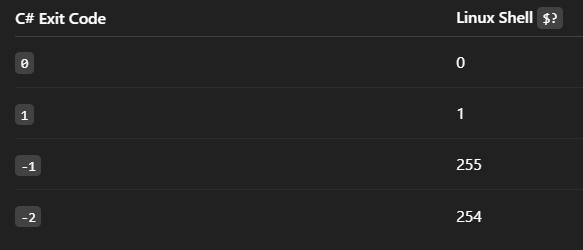
Key takeaway
- Linux exit codes are always unsigned 8-bit values (
0–255). - Returning negative values in your program gets wrapped modulo 256.
- Common convention:
0→ success- Non-zero → error
Tip:
If you want to return an error code to the shell, always use 0–255 to avoid confusion. Returning
-1is technically allowed but becomes255in the shell.Use 0 for success and 1–255 for errors to avoid confusion.
If you want a “standard” error code in Linux, just use 1 instead of
-1This is important to be aware of esp if you develop software using C# with mono or .net core where you might have a bash script that would automate task based on specific exit code from one of your linux C#/mono app.