5 principles of patrolling

There is a nasty version of the acronym though not shown here:
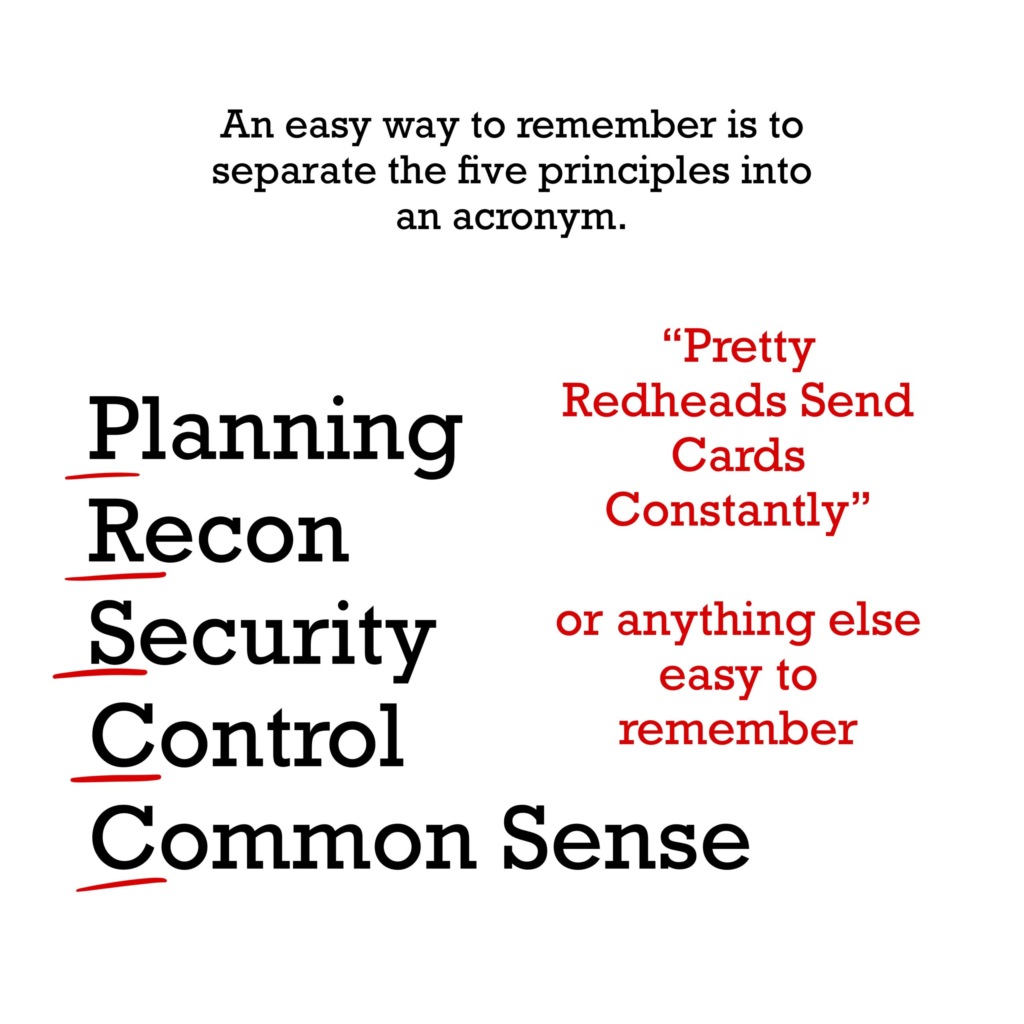
The five principles of patrolling are: planning, reconnaissance, security, control, and common sense

planning:

route planning, objective planning, and contigencies planning.

reconnaissance:

gather info about the area of operation through observation and exploration

security:

maintain awareness of potential threats and taking necessary precaution to protect the patrol from enermy.

control:

Maintaining order and discipline within the patrol, making sure all memebers know their roles and responsibilities

common sense:

Applying sound judgement and adapting tactics based on the situation on the ground, being flexible in tactics

The last three principles are especially important during the patrol itself . Security means that every direction of enemy approach is guarded at all times , so the patrol is not caught off guard . Control means that there is clear communication and execution on information between every Soldier in the patrol . Common Sense is can mean anything from the KISS principle ( “ Keep it simple stupid . ” ) , to , “ Don ’ t follow a plan if it ’ s a bad plan . ”

Leadership Positions

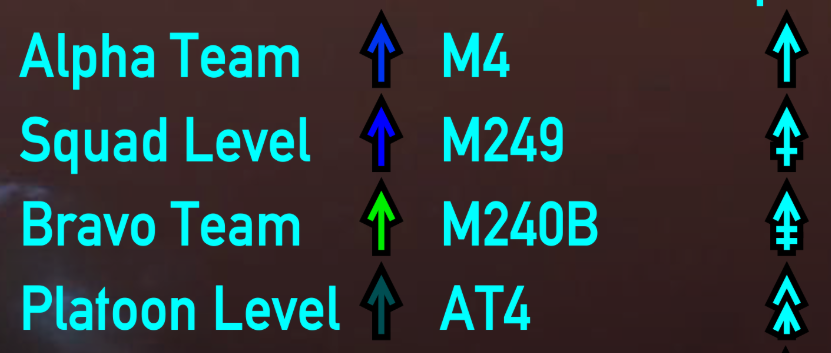
Alpha team (A team): the lead team
  • primarily responsible for land navigation
  • help B team with accountability when it needs to be done quickly.
Bravo team (B team): the trail team
  • primarily responsible for accountability
  • also responsible for water resupply and any emergency medical matters
Squad Leader
  • in charge of a squad (A & B team)
  • assigns tasks to entire teams
Weapons Squad Leader ( WSL , pronounced “ weasel ” )
  • leads all Gun Teams
  • in charge of cleanliness and maintenance of M240s
  • in a split location , the WSL controls the M240s nearest to him , while the other platoon – level leadership positions control the other M240s .
Platoon Sergeant ( PSG )
  • The senior advisor to the Platoon Leader (PL)
  • responsible for the accountability and health of all men , weapons , and equipment , and any medical evacuation
  • Before all movements , the PSG forms a choke – point with the Medic for accountability ( both silently count and verify each other ) .
Platoon Leader (PL)
  • in charge of the entire patrol, ensure that all the squads coordinate
  • Where there is a react – to – contact , for example , the Platoon Leader decides how many and which squads respond

Chain of Command – The first six in the chain of command for a platoon are Platoon Leader , Platoon Sergeant , Weapons Squad Leader , 1st Squad Leader , 2nd Squad Leader , and 3rd Squad Leader .

(And yes usually within a platoon there are about 3 squads and within each squad there are usually A & B team with a squad leader)

Team composition

Within a Team of a squad, these soliders are usually made up within a team of a squad:

  • Team Leader
  • Rifleman
  • Grenadier
  • Automatic rifleman (SAW gunner aka Squad Automatic Weapon gunner)
  • Medic: optional

Rifleman – A Soldier who carries a rifle . He has no subordinates , though the battlefield can change that . Throughout the patrol , he may be given simple standing responsibilities , such as delivering accurate rifle fire on the enemy in accordance with their leader ’ s scheme of maneuver and target precedence . Additional responsibilities may include compass checking , pace counting , and pack mule.

Squad Automatic Weapon ( SAW ) gunner – M249 is A light ( 17 lb . ) machine gun . Like an M4 rifle , it is designed to be fired from standing , kneeling and prone . However , unlike the M4 , the SAW Gunner cannot be accurate while kneeling or standing , and so he should be prone whenever the situation allows .


When I joined my company, I immediate was in placed as SAW gunner and never has been a rifleman. Being a SAW gunner is challenging, you need to be fit since you would wear full kit (body armor and helmet) plus carrring usually two SAW drums (200 rounds of 556 per drum) and one drum loaded. And you are required to run with these to your nearby cover and concealment when reacting to ememy contact (Battle Drill 1A) and if you are the B team (the rear team), usually your team would flank left or right to fire on the enemy from the side (or rear) while A team returned fire/suppress fire on the enemy so you would have to run as time is precious in battle so physical fitness is paramount.


Real story: During this year annual training oversea, due to a couple soldiers in gun team got sick so saw gunners were used as support by fire instead of gun team (usually gun team would be providing our support by fire) and we also were short of saw gunners so I volunteered to be saw gunner not just my squad but for other squad as well and if I recalled correctly we have to run about 300+ meters to our objective per iteration evolution ranged from dry, blank, and live so w/o working on my PT, I would not have been able to do it esp under extreme heat of our partnered country so yes PT is important.

(Within a squad, there are usually two teams: A team and B team and the squad leader)

Forward Observer ( FO )

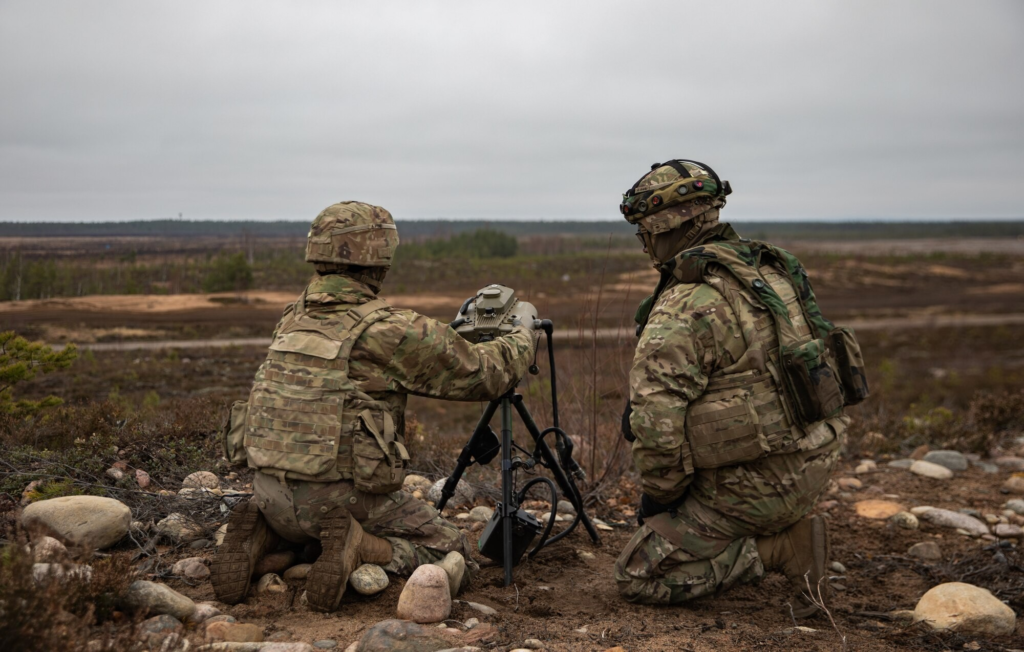
Forward Observer ( FO ) – A military observer who directs artillery and mortars onto targets. The FO stays close to either the Platoon Leader or the Weapons Squad Leader , to coordinate between the patrol and the fires .

Tools and Technology Used by Forward Observers

Forward Observers rely on a variety of tools and technologies to accurately identify and target enemy positions:

  • Laser Rangefinders:
    • These devices help FOs calculate the precise distance to a target, improving the accuracy of fire support.
  • Global Positioning System (GPS):
    • GPS technology helps FOs to pinpoint their own location and the target’s location with a high degree of accuracy, which is crucial for targeting artillery and airstrikes.
  • Binoculars/Spotters:
    • Observing targets from a distance requires high-powered binoculars or spotter scopes to identify potential targets. In modern warfare, this often includes thermal and night vision optics for operations in low-visibility conditions.
  • Radio Communication Systems:
    • FOs use secure radios to communicate with artillery units, air support teams, and command headquarters. These radios allow the FO to adjust fire based on observations and coordinate fire support in real-time.
  • Drones:
    • In some cases, FOs may utilize drones or unmanned aerial vehicles (UAVs) to gain an aerial perspective of the battlefield. Drones provide an excellent tool for observing targets over larger areas and for ensuring that fire support is accurately delivered.

Did you know “ weasel ” means WSL and What it stands for and what is meant?

It stands for Weapon Squad Leader (WSL) pronouned as weasel.

WSL is the squad leader of the gun team within weapon squad so usually weapon squad consiste of its squad leader (WSL) and his gun team. They usually provide fire support to A and B team of another infantry squad.

Weapon Squad usually consist of:

WSL is usually advised the Patrol Leader or Platoon Leader in a platoon-size element (PL). PL is usually a Second Lieutenant or Lieutenant (a lieutenan, junior commissioned officer rank)

Platoon Leader’s Typical Chain of Command:

  • Platoon Leader (Officer – usually 2nd Lieutenant – O1 or 1st Lieutenant – O2)
    • Platoon Sergeant (Enlisted Non-Commissioned Officer – NCO, often a Sergeant First Class, SFC – E7)
      • Squad Leaders (Typically Sergeants or Staff Sergeants, SSG – E6)
        • Team Leaders (Typically Seargeants, SGT – E5)
          • Soldiers (Ranging from Privates to Specialists, SPC)